Thursday, July 19, 2012

Gueules Noires: the mining lithographs of Theophile Alexandre Steinlen

Théophile-Alexandre Steinlen (1859-1923) is celebrated for his posters for the Chat Noir nightclub, and his lithographs of languid ladies with cats. But he also had a strong social conscience, and in this post I want to look at his powerful images of working men, and in particular his lithographs for the novel Les Gueules Noires (The Miners, literally The Black Mouths or Black Faces) by Emile Morel. This novel is a kind of companion piece to the more famous Germinal by Steinlen's friend Emile Zola. It was published in 1907 by E. Sansot, with 16 lithographs by Steinlen printed by Eugène Vernan. The ordinary edition on wove paper has no limitation, though it is not common. In addition to this trade edition there were 25 copies on Japon Impérial and 5 copies on Chine; these numbered copies have the lithographs in two states, in black as in the regular edition and in sanguine. I have no. 10 of the 25 copies on Japon. Here are the paper wraps, in both states:

Théophile-Alexandre Steinlen, La Sortie de la mine (Crauzat 269)
Lithograph, 1907


Théophile-Alexandre Steinlen, La Sortie de la mine (Crauzat 269)
Lithograph, 1907 (sanguine version, without lettering)


As this was the cover of the book, inevitably there are folds either side of the spine, and this image is particularly vulnerable to damage and paper loss. There exists an unfolded poster incorporating the cover lithograph, a lovely thing that can be seen in this post at Livrenblog. There are visual similarities with an earlier lithograph, Ouvriers sortant de l'usine:


Théophile-Alexandre Steinlen, Ouvriers sortant de l'usine (Crauzat 254)
Lithograph, 1903

These two lithographs alone show a powerful empathy with the industrial workforce that was rare among artists and art-lovers at this time. Although the Impressionists incorporated factory chimneys into their landscapes, their figure studies and interiors reflect the life of the well-to-do, not the poor. Vincent van Gogh, of course, plunged himself with heroic compassion into the lives of the mining families of Belgium, and Frank Brangwyn (about whom I'll post at some future date) was making similar studies of factory workers at the same time as Steinlen. Steinlen's friendship with Zola, and his position as a regular contributor to the left-leaning satirical journals Le Rire and L'Assiette au Beurre, mark him as someone who regarded art as an instrument of social change as well a means of personal expression. There is something quite haunting to me about the hunched and desperate figures in the lithographs for Les Gueules Noires, and the grim attention that Steinlen pays to the tiny details of their daily lives. Here are the fifteen single-page lithographs, alternately in sanguine and black:

Théophile-Alexandre Steinlen, La Descente (Crauzat 270)
Lithograph, 1907

Théophile-Alexandre Steinlen, Le Mouilleur (Crauzat 271)
Lithograph, 1907

Théophile-Alexandre Steinlen, La Paye (Crauzat 272)
Lithograph, 1907


Théophile-Alexandre Steinlen, Idylle (Crauzat 273)
Lithograph, 1907

Théophile-Alexandre Steinlen, Les Trieuses
Lithograph, 1907
(N.B. Crauzat left this lithograph out of his catalogue raisonné by mistake, presumably misled by the fact that the cover claims a total of 15 lithographs when there are actually 16; hence the title for this lithograph is mine, and I suggest a catalogue number of Crauzat 273a)

Théophile-Alexandre Steinlen, Solitude (Crauzat 274)
Lithograph, 1907

Théophile-Alexandre Steinlen, L'Train des Gueules Noires (Crauzat 275)
Lithograph, 1907

Théophile-Alexandre Steinlen, Le Marchand de gaufres (Crauzat 276)
Lithograph, 1907

Théophile-Alexandre Steinlen, Combat des coqs (Crauzat 277)
Lithograph, 1907

Théophile-Alexandre Steinlen, Baptême (Crauzat 278)
Lithograph, 1907
(Crauzat 279 is a redrawn version of this subject for a subsequent edition)

Théophile-Alexandre Steinlen, Le Directeur (Crauzat 280)
Lithograph, 1907
(Crauzat 281 is a redrawn version of this subject for a subsequent edition)

Théophile-Alexandre Steinlen, La Catastrophe (Crauzat 282)
Lithograph, 1907

Théophile-Alexandre Steinlen, La Reconnaissance (Crauzat 283)
Lithograph, 1907

 Théophile-Alexandre Steinlen, L'enterrement (Crauzat 284)
Lithograph, 1907

Théophile-Alexandre Steinlen, La Veillée (Crauzat 285)
Lithograph, 1907

My final image must be one of the last created by Steinlen, who died on 14 December 1923 at the age of 64; it shows his continuing commitment to recording the plight of the poor and downtrodden.

Théophile-Alexandre Steinlen, Le Vagabond
Etching, published posthumously in 1924

 Ernest de Crauzat (who compiled the catalogue raisonné of his prints) concluded a tribute to Steinlen published in Byblis in 1927 with the simple words, "Steinlen ne quittera plus jamais Montmartre": Steinlen will never again leave Montmartre.

Wednesday, June 20, 2012

Felix Bracquemond and Impressionism


The etcher Félix Bracquemond was a towering figure in nineteenth-century French printmaking, a fact which was recognised when in 1900 he won the Grand prix de gravure at the Exposition Universelle in Paris. Over the course of a long career he worked in various styles, producing over 800 prints, but essentially he is one of those figures who form a bridge between the Barbizon School and the Impressionists, having close links with both groups. His discovery of the woodcuts of Hokusai in the late 1850s is often seen as the start of French Japonisme.

Paul Rajon, Bracquemond (en 1868)
Etching, 1897

Félix Bracquemond was born Joseph Auguste Bracquemond in Paris in 1833. Brought up in a stable, he entertained youthful dreams of becoming a circus rider. Around 1848, he was instead apprenticed to a lithographer. Taking drawing lessons in the evenings, Bracquemond was noticed by Guichard, a former pupil of Ingres. He persuaded the boy's parents to let him leave his apprenticeship and become Guichard's pupil. Bracquemond made his debut at the Salon of 1852.

Félix Bracquemond was one of the pioneers and shapers of the French etching revival. It was Guichard encouraged him to learn etching, without being able to offer any practical help; undeterred, Bracquemond learned the techniques from an old encyclopedia. From 1862 Bracquemond was the driving force of the Société des Aquafortistes. Félix Bracquemond was generous with his advice and help to other artists who wanted to learn how to etch, including Corot, Courbet, Théodore Rousseau, Degas, and Fantin-Latour. Like most etchers and engravers of the time, Bracquemond earned his bread and butter by creating interpretative or reproductive etchings after the work of others. My first Bracquemond etching, dating from 1859, is one such piece, etched after a painting by the seventeenth-century Spanish painter Francisco Herrera the Elder. The second is a portrait of the artist Paul Chenavard, who like Guichard (and later Bracquemond's wife-to-be Marie Quiveron) was a pupil of Ingres; this may be after a photograph. The third is a portrait of the 18th-century artist Simon Mathurin Lantara, after a drawing by his friend Horace Vernet.

Félix Bracquemond, Saint Basile
Etching, 1859, after a painting by Francisco Herrera the Elder

Félix Bracquemond, Paul Chenavard
Etching, 1860

Félix Bracquemond, Lantara
Etching, 1864, after a drawing by Horace Vernet

Because of his friendship with Impressionists such as Manet, Degas, Cassatt, and Caillebotte, Félix Bracquemond was invited to exhibit at the Impressionist Exhibitions of 1874 (the first), 1879, and 1880. At the First Impressionist Exhibition, Félix Bracquemond was I think the most prolific exhibitor, showing a total of 32 prints. He was joined in the 1879 and 1880 exhibitions by his wife Marie, who was one of the most significant female Impressionists, alongside Eva Gonzalès, Mary Cassatt, and Berthe Morisot (another pupil of Guichard). Marie Bracquemond also exhibited at the last Impressionist exhibition in 1886, this time without her husband. My next Bracquemond etching is an interpretative work after a painting by the Barbizon-linked painter Charles Chaplin, who taught both Mary Cassatt and Eva Gonzalès; Chaplin's atelier was the only place in Paris that accepted female students, apart from the Académie Julian.

Félix Bracquemond, Le miroir
Etching, 1867, after a painting by Charles Chaplin

The Bracquemonds' son Pierre left a sour memoir full of resentment towards his father, whom he saw as domineering and unsympathetic. From this, the idea has gained currency that Félix Bracquemond stood in his wife's way, relentlessly criticising her and eventually bullying her into giving up her art. The current Wikipedia entry on Marie Bracquemond talks of, "his campaign to thwart her development as an artist," and says that "His objection to her art was not on the basis of gender but on the style she adopted, Impressionism." Later the article speaks of his "disgust" when Monet and Degas became her mentors. This is not just simplistic, but plain wrong. Félix Bracquemond was an early pioneer of Impressionism, as his 1868 series of 8 etchings, La Seine au Bas-Meudon, clearly shows. He was as keen as any of the Impressionists to capture the fleeting effects of light on the landscape, and even called some of his landscape studies of this period croquis impressionnistes. I wish I had one of these sparkling early Impressionist etchings to share with you.

Although no doubt Félix did have a strong and perhaps overbearing personality, and although his own devotion to the severe delights of black-and-white stands in opposition to Marie's lush sense of colour, the notion that he hated either her art or Impressionism in general is clearly nonsense. Not only did Félix exhibit with the Impressionists, he did so jointly with Marie. It was Félix who introduced her to Monet and to Degas, to Sisley who became one of their closest friends, to the art critic Gustave Geffroy, who championed her work, and to Paul Gauguin, who influenced her colour sense profoundly. Here is what Félix actually had to say about Marie's art, as quoted by Jean-Paul Bouillon in his chapter on Marie Bracquemond in Pfeiffer and Hollein, Women Impressionists: "She has never turned out masses of work, preferring complete, properly finished pictures. And because she's sick and disheartened, her oeuvre is small. As a result, she's pushed aside as being useless. It's stupid and cruel."

Félix Bracquemond, La terrasse de la Villa Brancas
Etching, 1876, proof avant la lettre

The most telling evidence of Félix's admiration and love for his wife lies in what I think is one of his finest etchings, La terrasse de la Villa Brancas, which was created in 1876, published by the revue L'Art in 1878, and exhibited at the 4th Impressionist Exhibition in 1879. It shows Marie on the terrace of their home in Sèvres, painting her sister Louis Quiveron, in the new Impressionist style she had adopted after the revelation of the First Impressionist Exhibition. Félix depicts his wife not as a mother, not as a domestic goddess, not as an object of male desire, but as an artist. Not just an artist, but an Impressionist artist, a fact which he conveys in his own style, which is the essence of Impressionism. Jean-Paul Bouillon writes vividly about the triumph of this etching: "In this major work . . . the artist takes a clear stand on the issue of color and plein air painting, demonstrating that the effect of light can be fully rendered, independently of color, simply by masterful gradation and ordering of black and white values, from pure white for Louise's dress and the parasol directly catching the sun, through the deep black of Marie's costume. And at the same time he informs us that in the mid-1870s his wife was already engaging with this kind of subject matter." One of Marie's greatest paintings, called alternatively Sur la terrasse à Sèvres or by the same title as the etching La terrasse de la Villa Brancas, is a kind of colour riposte to the etching. It can be found in the Musée du Petit Palais in Geneva.


Félix Bracquemond, La terrasse de la Villa Brancas
Etching, 1876


I'm delighted to be able to show you two versions of La terrasse de la Villa Brancas. The first is a rare proof avant la lettre, before Félix has used a drypoint needle to credit L'Art in the bottom righthand corner, the title La terrasse below Louise's dress, and a credit to the printer, A. Salmon, in the bottom left. I can't see any differences in the actual image, beyond the added lettering, but there may be some minor changes.

Félix Bracquemond, Vue du Pont des Saints-Pères
Etching, 1877


Vue du Pont des Saints-Pères is another notable Impressionist etching, also published by L'Art, while Les trembles, which shows the influence of Sisley, was published by the Gazette des Beaux-Arts, and La surprise by the Revue de l'art ancien et moderne. Stylistically I wonder if Les trembles, which depicts aspens quivering in the breeze on the banks of the Seine, may date from earlier than its publication date of 1884.

Félix Bracquemond, Les trembles
Etching, 1884

Félix Bracquemond, La surprise
Etching, 1900

My next four etchings by Bracquemond were executed for a monumental work of 1895, La Mer by René Maizeroy, which contained 24 etchings by different hands. The first is the cover of the book, printed on thick buff-coloured paper.

Félix Bracquemond, La Mer
Etching, 1895

Félix Bracquemond, La Mer - frontispice
Etching, 1895

Félix Bracquemond, Le Mont Saint-Michel
Etching, 1895

Félix Bracquemond, Les mouettes
Etching, 1895

And finally, the last work I have from Bracquemond's hand, Loup dans la neige, or as it is titled in Zeitschrift für Bildende Kunst, Der Wulf im Schnee.

Félix Bracquemond, Loup dans la neige
Etching, 1907

As well as his etchings and lithographs, Bracquemond designed ceramics, notably for Sèvres (from 1870) and Haviland, whose experimental atelier in Auteuil he ran as artistic director from 1872. The Sèvres porcelain factory can be seen in the background of La terrasse de la Villa Brancas.

Loÿs Delteil, Bracquemond (en 1897)
Etching, 1897

Félix Bracquemond died in Sèvres in 1914; Marie survived him by two years.


Wednesday, June 6, 2012

The Etchings of Young Goethe

It's not surprising that many writers are also talented artists, and many artists also write. In some cases - David Jones is an obvious example - it's impossible to say which medium predominates. But I was still surprised to stumble across the accomplished etchings featured in this post, created by Johann Wolfgang von Goethe in 1768, at the age of 18.

William Unger, Goethe
Etching, 1881
after the 1779 portrait in oils by Georg Oswald May

Although he is remembered today as Germany's greatest writer, early in life Goethe was inclined to become a painter; his lifelong interest in art is evidenced in his book On Colour, and of course the hero of The Sorrows of Young Werther is an aspiring artist. While studying law in Leipzig from 1765-1768, Goethe took drawing lessons from Adam Friedrich Oeser, director of the Leipzig Academy, who became a key influence on him. It was Oeser who encouraged Goethe to take up etching, and taught him the technique.

Johann Wolfgang von Goethe, Landschaft nach A. Thiele (Dedié à Monsieur Goethe)
Etching, 1768


Johann Wolfgang von Goethe, Landschaft nach A. Thiele (Dedié à Monsieur le Docteur Hermann)
Etching, 1768


My two Goethe etchings were printed in 1893 from copper plates that had remained in the possession of a Leipzig family and were subsequently donated to the Leipzig city library. Both are interpretative etchings after landscapes by Alexander Thiele (1686-1752), and each has an etched dedication below the image, one to Goethe's father, and the other to his law teacher Dr. Christian Gottfried Hermann. The effect is rather like a pair of bookplates, though the etchings were not intended for use as exlibris.


Tuesday, May 22, 2012

Rediscovering Albert Varadi

I first came across the Hungarian artist Albert Váradi in the Parisian art revue Byblis. In 1924 he contributed a wonderfully raffish and dandified etched portrait of the editor of Byblis, Pierre Gusman (himself a distinguished printmaker). There was an accompanying essay on Váradi by Loÿs Delteil, and a catalogue raisonné of his etchings to date. Starting in 1920, Váradi had produced 64 etchings and drypoints by summer 1924, plus a further 15 etchings that appeared in two books, Boccaccio's Das Liebeslabyrinth and Heine's Die Harzreise. As both of these books were published in Germany, it would appear that Váradi was one of many displaced artists from Eastern and Central Europe who settled in the West after WWI, usually gravitating to Paris, but often via some other country first. I was intrigued, and decided to find out what I could about this talented artist. As it turns out, the Byblis article by Delteil and the accompanying catalogue seem to be the best information available, though there is also a substantial entry on Váradi in Marcus Osterwalder, Dictionnaire des Illustrateurs 1905-1965.

Albert Váradi, Portrait de Pierre Gusman
Etching, 1924

Albert Váradi was born in Nagyvárad in Transylvania on 16 October 1896; his birthplace, then in Hungary, is today known as Oradea and is now in Romania, so both Hungary and Romania may lay claim to him. Váradi started his studies at the Budapest Academy and then continued at the Budapest School of Decorative Art. Drawn to printmaking after five years concentrating on sculpture, Váradi went to Munich in 1920 (or late 1919) to learn the art of etching under Peter Halm. That he showed immediate promise in this new field is evidenced by the fact that his etchings for Boccaccio were published in an edition of 250 copies by Hesperos Verlag in 1921, and those for Heine in an edition of 350 copies by Paul Stangl Verlag the following year. My copies of the Heine etchings are, rather surprisingly, each individually hand-signed by Váradi, presumably for a friend.

Albert Váradi, Title page for Das Liebeslabyrinth
Etching, 1921

Albert Váradi, Etching for Das Liebeslabyrinth
Etching, 1921

Albert Váradi, Etching for Das Liebeslabyrinth
Etching, 1921

Albert Váradi, Etching for Das Liebeslabyrinth
Etching, 1921

In April 1923 Váradi moved to Paris, where he first exhibited in that year's Salon d'Automne. He produced etchings of Paris street scenes, beaches in Normandy, and portraits, which Loÿs Delteil thought his strongest work. Váradi did not make preparatory drawings, but drew directly onto the copperplate, like Paul Helleu and Marcellin Desboutin. Most of Albert Váradi's etchings were issued in tiny editions 10 or 30 copies, though two were more widely distributed: his portrait of Eugène Delâtre appeared in the Gazette des Beaux-Arts (c.1500 copies), and his portrait of Pierre Gusman was published in Byblis, Miroir des Arts du Livre et de l'Estampe (700 copies).

Albert Váradi, Title page for Die Harzreise
Etching, 1922

Albert Váradi, Etching for Die Harzreise
Etching, 1922

Albert Váradi, Etching for Die Harzreise
Etching, 1922

Albert Váradi, Etching for Die Harzreise
Etching, 1922

Sadly, Albert Váradi died in Paris in 1925, his promising career cut short at the age of just 28, having only been etching for five years. What the final total of his etchings was, I do not know, but the total of individual works, even counting the etchings for Boccaccio and Heine, is almost certainly less than 100.

Friday, May 18, 2012

Tender agony: the tragic fate of Pierre-Paul Prud'hon and Constance Mayer

In his day, Pierre-Paul Prud'hon (1758-1823) was one of the most famous and successful artists in France. His art is poised between the strict neo-classicism of David and Ingres and the lush romanticism of Delacroix and Géricault. While the others were a generation younger, David (1748-1825) and Prud'hon were almost exact contemporaries and therefore rivals. The older David despised the softness and sentimentality of Prud'hon's work, but it was precisely these qualities that appealed to the ladies of Napoleon's court (including both of his Empresses, Josephine and Marie-Louise). Prud'hon's openness to emotional content also pleased Delacroix and Géricault, who both admired and were influenced by his art. Prud'hon came from humble origins. He was born plain Pierre Prudon in Cluny in Burgundy, the thirteenth child of a stonecutter. The Pierre-Paul part of his working name was intended to suggest artistic kinship with Peter Paul Rubens; the fancified surname gives the vague suggestion of a landed or noble background.

Pierre-Paul Prud'hon, L'enfant au chien
Lithograph, 1822

Prud'hon hardly qualifies as a prolific printmaker. He made two etchings, and three authenticated and two attributed lithographs, and that seems to be it. Of the three undoubted original lithographs, I have one, a work of great style and authority. Entitled L'enfant au chien, it depicts the son of Maréchal Gouvion Saint-Cyr, and relates to a painting of the same subject exhibited at the Salon de Paris in 1822. The lithographic stones for this and another lithograph entitled La lecture were acquired in 1864 by M. Galichon for the Gazette des Beaux-Arts, which issued new editions (although possibly the works were never formally editioned prior to this). La lecture was included in the Gazette in 1870; although L'enfant au chien bears a credit to the Gazette as well as to the printer Bertauts, I can't find any record of it actually appearing in the revue. It is not listed in Pierre Sanchez and Xavier Seydoux's thorough and scrupulous catalogue, Les Estampes de la Gazette des Beaux-Arts. If anyone has access to the Gazette for 1869 and 1870, I would be grateful for any enlightenment as to whether L'enfant au chien is in there or not.

Alfred Taiée, Tombeau de Mlle C. Mayer et de Prud'hon
Etching, 1879

The date of 1822 is a notable one, because it means this tender study of a boy and his dog was executed while Prud'hon himself was suffering intolerable agony. Prud'hon had married at the age of 19. The marriage was unhappy, although the couple had six children, and his wife was eventually admitted to an insane asylum. From 1803, Prud'hon's intimate partner in both life and art was his ex-pupil Constance Mayer. There's a good post on their relationship here, at The Jade Sphinx. Supposedly, on her deathbed, Mme Prud'hon begged him never to re-marry, and he vowed that he would not. When Constance Mayer heard the news, she went to Prud'hon's studio, picked up his cutthroat razor, and slit her throat. Prud'hon was devastated by Mayer's death, sank into depression, and died himself in 1823. The lovers were buried in the same tomb in Père Lachaise; I have an etching of this by Alfred Taiée.

Engraving by an unknown hand after a drawing by
Pierre-Paul Prud'hon of Constance Mayer, c.1805

The remaining images in this post are etchings after Prud'hon, Mayer, or Prud'hon and Mayer combined. One of the puzzles with Prud'hon is exactly where his work stops and Constance Mayer's starts. He seems to have enjoyed drawing more than painting, and left a good deal of the execution of his large allegorical paintings to her; so much so that some authorities now credit the works to both artists. Constance Mayer was also an artist in her own right, with her own studio and her own pupils, and her work under her own name is certainly very similar to that of Prud'hon.

Léopold Flameng (1831-1911), etching after
Pierre-Paul Prud'hon, Vénus au bain, ou L'innocence
1863

Adolphe Lalauze (1838-1906), etching after
Pierre-Paul Prud'hon and Constance Mayer, L'innocence préfère l'amour à la richesse
1876

William Barbotin (1861-1931), etching after
Pierre-Paul Prud'hon, L'amour et l'innocence
1903

Arthur Mayeur (1871-1919), etching after
Pierre-Paul Prud'hon, Nymphe et amours
1903

Prud'hon began to study drawing at the age of 16, at the Académie des Beaux-Arts de Dijon under François Devosge. In 1780 he entered the Royal Academy, then based in the Louvre. Two years after that, he won the a Burgundian three year scholarship to live and study in Rome. The years he then spent in Italy were crucial to his artistic development. According to the J. Paul Getty Museum biography, "his experience in Italy from 1784 to 1787, when he absorbed the softness and sensuality of Correggio's works and Leonardo da Vinci's sfumato, gave his art its distinctive style." His mastery of tonal effects in academic figure drawing has never been equalled.
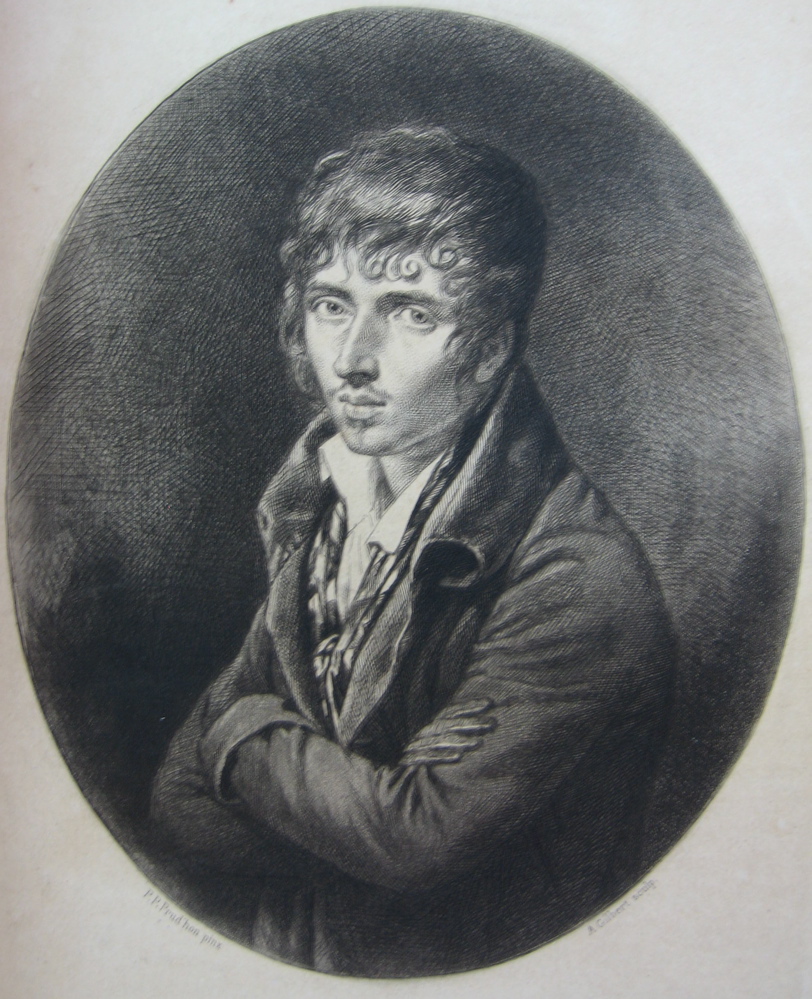
Achille Gilbert (1828-1899), etching after
Pierre-Paul Prud'hon, Portrait de Millevoye
1880

Jules G. Romain, etching after
Pierre-Paul Prud'hon, Portrait de Mlle Pierre de Vellefrey
1907

There's a good essay on Prud'hon by Fred Stern here, relating to the Prud'hon exhibition at the Metropolitan Museum, New York, in 1998.

Eugène Gaujean (1850-1900), etching after
Constance Mayer, Le rêve de bonheur
1879

Constance Mayer (full name, Marie-Françoise-Constance Mayer La Martinière) was born in Paris in 1775, seventeen years Prud'hon's junior. Like him, she had a meteoric rise in the art world, first exhibiting at the Paris Salon in 1796. She studied under Joseph-Benoît Suvée and Jean-Baptiste Greuze, and admired Prud'hon's artistic adversary Jacques-Louis David. Why in 1803 she would need to enrol as a pupil with Prud'hon is not immediately apparent, and it seems likely that the status of élève was a convenient mask for their affair, rather than a full master-pupil relationship. It was Constance who suffered from this subterfuge, because it meant that she was always viewed in the shadow of the master. No one knows how many drawings and paintings now attributed to Prud'hon are actually the work of Constance Mayer. Her 1805 painting Vénus et l’Amour endormis caressés et réveillés par les Zéphirs, ou Le sommeil de Vénus, for instance, initially bought by the Empress Josephine, when it passed into the collection of Sir William Wallace, had Mayer's signature removed and replaced by that of Prud'hon. Apart from anything else, a nude by a female artist was not to be thought of. The painting remains in the Wallace Collection, now reattributed to Mayer, though their description still maintains that Prud'hon provided the "initial ideas": i.e. he did the preparatory drawings and Mayer merely painted his design.

Augustin Mongin (1843-1911), etching after
Constance Mayer, Portrait de Mlle Sophie Lordon
1879

Constance Mayer killed herself in Prud'hon's Paris studio on 26 May 1821. He withered without her, and died of consumption on 16 February 1823.