Friday, September 24, 2010

Explosions of colour: Walasse Ting

The painter and lithographer Walasse Ting, who died earlier this year, occupies a unique place in the dialogue between American and European art in the 1960s. Ting was an outsider to both cultures. He was born Ding Xiongquan in Shanghai in 1929. After studying briefly at the Shanghai Art Academy, he left China in 1946, living initially in Hong Kong before sailing to France in 1950. In Paris, Walasse Ting came under the influence of the artists who made up the avant-garde group CoBrA, most notably Pierre Alechinsky, Karel Appel, and Asger Jorn. In 1958, Ting moved to America, where his closest associate was the Abstract Expressionist painter Sam Francis. In 1964, Walasse Ting and Sam Francis collaborated on one of the greatest artist’s books of the period, a collection of Ting’s stream-of-consciousness Pop Art poems illustrated with original lithographs by a total of 28 artists, entitled One Cent Life. Unfortunately I don’t have a copy of this, but it’s a remarkable work, and particularly notable for the way in which it mixes the slick Pop Art of Americans such as Andy Warhol with the turbulent work of the CoBrA artists. Whereas in the USA Pop Art concerned itself largely with surfaces, as a comment on consumerism, in Europe it concerned itself with structures, as a critique of consumerism. A typical CoBrA work is a violent, semi-abstract, distorted, highly-sophisticated version of a child’s drawing. There are echoes of folk art and tribal art, and a sense of rejection of society’s falsely-imposed sense of order and respectability. Walasse Ting could straddle both these worlds, and it is largely due to his One Cent Life that one can even speak of a single Pop Art movement, embracing both the Americans and the Europeans. 

Pierre Alechinsky. Hommage à Aimé et Marguerite Maeght
Lithograph, 1982

Sam Francis, Noise
Lithograph, 1989

Like his friends Sam Francis and Joan Mitchell, Walasse Ting was very open to European ideas, and it is these three above all who incorporated into American Abstract Expressionism the aesthetics of the gestural semi-abstract European style known as Art Informel (which, in turn, was profoundly influenced by de Kooning and Pollock). From the mid-1970s Wallace Ting’s art became much more figurative and decorative, concentrating on brightly-coloured images of naked women, flowers, birds, horses, and other animals, in a vivid dreamscape of sensual pleasure. These works, painted in acrylics with a Chinese brush on rice paper, have a great deal of charm and vivacity (you can see a selection here), but I prefer his more challenging earlier work. Wallace Ting’s lithographs of the 1960s simply explode onto the page in an orgasmic riot of colour. There’s a rawness and immediacy to his work of this period that really appeals to me.

Walasse Ting, Untitled composition 1
Lithograph, 1963

Walasse Ting, Untitled composition 3
Lithograph, 1963

Walasse Ting, Untitled composition 6
Lithograph, 1963

Walasse Ting, Untitled composition 9
Lithograph, 1963

My first Walasse Ting lithographs are all untitled compositions from the catalogue to his 1963 exhibition at the Galerie Birch in Copenhagen. The lithographs were printed by Permild and Rosengreen.

Wallace Ting, Butterfly gun
Lithograph, 1967

Walasse Ting, Iris bursting
Lithograph, 1967
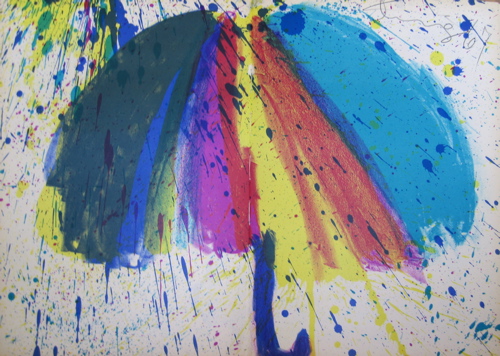
Walasse Ting, Singing in the rain
Lithograph, 1967

Walasse Ting, Twinkling star
Lithograph, 1967

My next group of lithographs, also printed by Permild and Rosengreen, were made in 1967 for Walasse Ting’s collection of classical Chinese poetry, in his own translations, Chinese Moonlight. The lithographs were bound into the book, so have a central vertical fold and minute thread holes; on the plus side, all four of mine are boldly signed in pencil Ting ’67; the book is additionally inscribed by Ting to John Schiff.

Walasse Ting, Someone make love
Lithograph, 1969

Walasse Ting, Love is many splendored thing
Lithograph, 1969

Walasse Ting, Male order
Lithograph, 1969


Walasse Ting, Chicken chow mein
Lithograph, 1969

Walasse Ting, Rainbow as thread
Lithograph, 1969

Walasse Ting, Dedicated to all prostitutes in the world
Lithograph, 1969

My final Walasse Ting lithographs, printed by Bjørn Rosengreen and published by the Sam Francis Foundation, come from his poetry collection Hot & Sour Soup. My copy of this was inscribed by Ting to the influential art critic of the New York Times, “To John Canaday, Sunshine as best wishes, moonlight as desert, from Walasse Ting 22 October 1969 NYC”.

Walasse Ting, Dragonflies mating
Ink drawing, 1969

And last of all I have a single Walasse Ting ink drawing, boldly drawn on a blank page of Hot & Sour Soup for John Canaday.

Walasse Ting, 1929-2010
Photographed in 1963

In his later years Wallace Ting lived in Amsterdam, making frequent trips to both New York and Tahiti. He ceased painting in 2002 after suffering a severe stroke, and died in New York on May 17, 2010.

Thursday, September 2, 2010

A master of engraving: Albert Decaris

Copper plates were, until about 1820, the only metal on which intaglio prints, either engravings or etchings, were made. As Bamber Gascoigne explains in his excellent book How to Identify Prints, steel plates were first used in the 1820s "to print long runs of banknotes which would remain identical throughout the run and which would be so finely engraved as to make forgery difficult." The harder metal was more difficult to work with, but enabled very fine detailing, and the plates never wore out. Steel plates became popular for various kinds of subjects, notably topographical views, which might be printed in large numbers to appeal to tourists. From the 1850s it was possible for artists to work on the more forgiving copper plates, which were then subsequently "steel-faced", a process in which a thin layer of iron is electro-plated to the surface of the copper, thereby extending the life of the plate. Steel plates remained the choice for banknotes and postage stamps, copper for fine art. But one important twentieth-century engraver, Albert Decaris (1901-1988), made engraving on steel his life's work. Decaris seems to have valued steel for the immaculate clarity of line that can be achieved, and for the shimmering effect that such lines produce when engraved in parallel. Albert Decaris engraved over 500 postage stamps for the French and French colonial postal services, and also illustrated a large number of books. I have 3 sets of prints by Decaris, showing different aspects of his art. All exhibit an astonishing technical virtuosity, but they can feel a bit stark. For that reason my favourites are his engravings of Paris, which are not just detailed and evocative but full of warm feeling for the city he loved.

Albert Decaris, Île de la Cité
Engraving, 1950

Albert Decaris, Feux d'artifice sur la rive droite
Engraving, 1950

Albert Decaris, Feux d'artifice sur la rive gauche
Engraving, 1950

Albert Decaris, Montmartre et le Sacré Coeur
Engraving, 1950

Albert Decaris, Rue Drevet à Montmartre
Engraving, 1950

Albert Decaris, Rue Broca
Engraving, 1950

Decaris's studio was on the left bank of the Seine, with a view over the river and the Louvre. The wood engraver Mark Severin visited him there in 1950, and wrote in his essay "Decaris, engraver" in The Studio, "One's first impression on a visit to the studio of Decaris is of constellations of little white metal splinters scintillating like stars on the dark floor, which has suffered from the continuous shower, and then of the window opening on the Seine and the Louvre."

Albert Decaris, Notre-Dame et la rive gauche
Engraving, 1950

Albert Decaris, La rive droite et le Louvre
Engraving, 1950

These magnificent views of Paris were made for the book Paris by André Suarès. This was published in 1950 in an edition of 250 copies, all printed on Montval laid paper. Additionally there were 50 separate suites of the engravings printed on Auvergne paper, and 25 albums of the engravings. My images show the engravings as they appear on the handmade Auvergne paper of one of the 50 suites. The engravings were printed by Georges Visat.

Albert Decaris, Florence
Engraving, 1930

Albert Decaris, Pisa
Engraving, 1930

Albert Decaris, Street in Siena
Engraving, 1930

Paris was not the only city to play an important role in the life of Albert Decaris, for in 1919 at the age of just 18 he won the prestigious Grand Prix de Rome for engraving, which entitled the winners to an extended period in the Villa Medici in Rome to further their studies. Decaris's time in Rome, though interrupted by illness and then by military service, was crucially important to him, and Italian subjects seem to have appealed strongly to him. This made the commission to illustrate the travel book Du Sang, de la Volupté, et de la Mort by Maurice Barrès, which is set largely in Italy and Spain, a perfect choice for Decaris. This was published in 1930 in an edition of 316 copies, with 85 separate suites of the engravings printed on B.F.K. Rives by Edmond Rigal; again, my photos show one of the suites.

Albert Decaris, Women of Seville
Engraving, 1930

Albert Decaris, Bullfight
Engraving, 1930

Albert Decaris, Spanish fiesta
Engraving, 1930

As can be seen from the illustrations above, after Albert Decaris had formed his mature style it did not alter or develop much. 20 years separate the two series of prints, but you would never guess it. My third set of prints comes from 1967, when Decaris illustrated a monumental edition of Plutarch's Lives. I don't have this 3-volume work, but instead a publisher's sample, with 21 of the 58 full-page engravings, which were printed by Serge Beaune on Marais wove paper. This publication really took advantage of the hard-wearing quality of steel plates, being issued in an edition of 3600 copies (of which I believe 100 were on Antique Bellegarde paper, with a double suite of 8 "planches refusées"). Because I don't have the text, I am left in a few cases guessing precisely what subject is depicted in the images. These vigorous engravings show no slackening of skill, but lack, for me, the personal element that gives the depictions of Paris their particular charm.

Albert Decaris, Theseus and the Minotaur
Engraving, 1967

Albert Decaris, Cleopatra
Engraving, 1967

Albert Decaris, Caractacus in chains(?)
Engraving, 1967

Albert Decaris, The ruins of Athens (?)
(Any ideas as to who this solitary brooding figure is?)
Engraving, 1967

Albert Decaris was born in Sotteville-les-Rouen in the Seine-Maritime, and died in Paris. Although he was highly respected as an artist and achieved various high honours - elected to the Institut in 1943, named an official "peintre de la Marine" in 1973 - his decision to concentrate on commissioned work such as book illustrations and postage stamps meant that his art has not received the attention you would expect for the youngest person ever to win the Grand Prix de Rome, and the first person ever to win the Medaille d'Argent at the Paris salon with his first exhibit. His art may be severe, but it is also meticulously observed, and rendered with extraordinary skill. I'll leave the last words to Mark Severin, who wrote, "The refinement as much as the sublimity of his art, which is essentially typically French, makes him one of the great masters of engraving."

Tuesday, August 31, 2010

Cubist pochoirs

"Everything in nature takes its form from the sphere, the cone, and the cylinder," wrote Paul Cézanne. It was the major Cézanne retrospective in Paris in 1907, together with Picasso's discovery of African and Oceanic art around the same time, that gave rise to the Cubist movement which propelled art into the twentieth century and the machine age. Picasso's famous 1907 painting Les Demoiselles d'Avignon shows Cubism in its earliest formative stage; its fractured perspectives derive, I believe, from Picasso's memories of the endless reflections he had glimpsed in the heavily mirrored brothels of the barrio chino in Barcelona, where the painting is set. In 1907 and 1908 Picasso, in close collaboration and friendly rivalry with Georges Braque, worked out the template for Cubism, an art in which the single perspective of a static onlooker is replaced by the multiple perspective of an all-seeing eye.

Pablo Picasso, Three Musicians
Pochoir after a painting
from Eugenio d'Ors Pablo Picasso 1930


Georges Braque, La Bouteille de Marc
Pochoir after a collage
from XXe Siècle, 1956


While Picasso and Braque were generous and open in sharing their discoveries with fellow artists, they were in no hurry to exhibit this ground-breaking work, and the first the general public knew of this radical new art was the Cubist room at the Salon des Indépendants in spring 1911, which showed work not by Cubism's originators but by their followers, who called themselves the Section d'Or. This same group staged an exhibition the following year at the Galerie La Boetie in Paris, to mark the publication of Du Cubisme by two of the members, Jean Metzinger and Albert Gleizes. America's introduction to Cubism came through a series of drypoints by Jacques Villon (who gave the Section d'Or its name), exhibited at the Armory Show in New York in 1913.

Henri Laurens, Nature Morte
Pochoir after a painting
from XXe Siècle, 1956

I've just acquired a copy of Guillaume Janneau's 1929 study L'Art Cubiste, which was enhanced by 12 pochoir (hand-stencilled) plates. The tricky task of cutting the stencils and hand-applying the gouache colour was entrusted to one of the masters of pochoir, Daniel Jacomet. I only have 11 of these plates (one by Léger is missing), but here they are, to give an overview of the movement, and the individual approaches developed by the various artists who followed in the wake of Braque and Picasso.

Georges Braque
Pochoir after a painting
from L'Art Cubiste, 1929

Pablo Picasso
Pochoir after a watercolour
from L'Art Cubiste, 1929

Albert Gleizes
Pochoir after a gouache
from L'Art Cubiste, 1929

Auguste Herbin
Pochoir after a watercolour
from L'Art Cubiste, 1929

Louis Marcoussis
Pochoir after a painting
from L'Art Cubiste, 1929

Georges Valmier
Pochoir after a watercolour
from L'Art Cubiste, 1929

Henri Laurens
Pochoir after a watercolour
from L'Art Cubiste, 1929

André Lhote
Pochoir after a gouache
from L'Art Cubiste, 1929

Pablo Picasso
Pochoir after a painting
from L'Art Cubiste, 1929

Juan Gris
Pochoir after a watercolour
from L'Art Cubiste, 1929

Fernand Léger
Pochoir after a watercolour
from L'Art Cubiste, 1929

Monday, August 30, 2010

More on Jeanne Bardey

I've been doing a little more digging on Jeanne Bardey (still without sight of the book on her by Hubert Thiolier). According to the Union List of Artist Names at the J. Paul Getty website, Jeanne Bardey's dates were 1876-1944, so it seems she was 7 years younger than I thought, and died 4 years earlier: I can't remember where I got my previous dates, but these seem more reliable. [Though apparently not: see the update at the foot of this post]. I have found several works by her illustrated in the Gazette des Beaux Arts, and a short essay on her in the Gazette's series Peintres-Graveurs Contemporains. The essay, published in 1913 and accompanied by the etched portrait reproduced in my last post, is by R. M. (presumably the art critic Roger Marx). Sorry for the poor quality of the images in this post, which are simply quick photos of reproductions in the Gazette, but it seems worthwhile posting what I can on this underservedly obscure artist, about whom so little information is readily available.

Jeanne Bardey, Étude
Fresco, 1911

The first mention I find of Jeanne Bardey is in a round-up article on Les Salons de 1911. Her fresco of a seated female nude is reproduced (taking up most of a page), and discussed by the author René Jean. It was exhibited at the Salon des Artistes Indépendants. Jean remarks on Jeanne Bardey's "very personal" fresco technique, in which the drawing is incised into a brick red ground. He asks, "Quelle est le part de M. Rodin, le maître de Mlle Bardey, dans ces nouvelles recherches? Peu importe: pour l'heure, il suffit de se laisser aller au charm bizarre que donne cette figure inclinée, les bras tendus au dossier du fauteuil tournant qui la reçut. Cette fille d'Ève offre et refuse à la fois le secret de ses lèvres ouvertes et de son regard fuyant: l'artiste qui la conçut avait la perception douloureuse d'une humanité à la poursuite vaine des oublis factices." What is the part of M. Rodin, the teacher of Miss Bardey, is these new researches? No matter: for now, it is enough to open oneself to the strange charm of this inclined figure, her arms outstretched to the back of the revolving chair on which she sits. This daughter of Eve both offers and refuses the secret of her opened lips and her elusive gaze: the artist who conceived her had a painful perception of a humanity in vain pursuit of false oblivion.

Jeanne Bardey, Ophèlie
Marble sculpture, 1913

After René Jean's rather over-excited response to the fresco nude, Roger Marx (if it is he) is more measured in his assessment of the art of Jeanne Bardey. He opens by acknowledging that, "It is a common experience to witness the rise to fame of a favoured female pupil of some independant master." He instances Judith Leyster and Frans Hals, Margeurite Gérard and Frago, Constance Mayer and Prud'hon, Eva Gonzalès and Manet, Mary Cassatt and Degas, "et, auprès de M. Rodin, Mlle Camille Claudel et Mme Jeanne Bardey." I note that throughout this article the artist is Mme Bardey, rather than Mlle as before. There's a reference on the internet to a visiting card of Rodin's inscribed, "Madame Bardey one of my friends has a talent that you will see. Your friend Aug. Rodin", presumably sent to introduce her to some art world luminary, but no date is given. It seems from what Roger Marx writes that Bardey was her married name, and that her husband was the Lyonnais artist Louis Bardey. Louis Bardey, described by Roger Marx as a "decorator", who had studied under Guichard, was born in 1851. I can't find a death date for him, but he is described as still active in 1913. He is described as Jeanne Bardey's first teacher.


Jeanne Bardey, Figure en marbre
Marble sculpture, 1913

Although Jeanne had shown a marked artistic talent since her schooldays, it was only in 1905, when she was nearing 30, that she commenced her artistic career. In 1907 she exhibited a still life at the Salon de Lyon, which was bought by the town for its museum; so far as I can tell this was her first publicly exhibited work. Buoyed-up by this success, Jeanne Bardey went to Paris to continue her studies, both in the academies and in hospitals and asylums where "she set herself to surprise on the faces of the insane and degenerate the flaws of imbalance and the stigmata of bewilderment and madness." Besides these studies of the mentally ill, Bardey filled sketchbooks with quick drawings of the human body in motion, and of nudes. It was these drawings that persuaded Rodin to take her into his atelier. "Drawing will give you the key to all the arts," he told her. At this period she branched out into etching, returned to painting,  made frescos. In 1911, under Rodin's guidance, she took up sculpture, "kneading clay, shaping marble from Asia or Sienna, or making bas-reliefs on Carrera marble in the Egyptian style."

Jeanne Bardey, Rieuse
Painting, 1913

Roger Marx concludes by saying that. "Mme Bardey leaves the impression of an artist who maintains, in the successful pursuit of powerful achievements, a nature inherently inventive, a delicate taste, refined by culture and a determined, lucid, and sensitive will." Despite this early acclaim, Jeanne Bardey did not become a famous artist. After Rodin's death in 1917 she lost her main promoter. So far as I can tell she retreated from Paris to Lyon, though whether she ever returned to Louis Bardey is unclear. She did continue to exhibit until the early 1930s. Having commenced at the Salon des Artistes Indépendants in 1908-1910, and the Salon des Artistes Décorateurs in 1911-1912, from 1913-1933 she moved her allegiance to the Salon d'Automne, the Salon des Tuileries, and the Salon de la Société Nationale des Beaux-Arts, of which she was elected a member in 1930.

UPDATE 13 June 2011: André Vessot kindly informs me that Jeanne Bardey was born in Lyon on August 10, 1872 and died in Lyon on October 8, 1954.

Friday, August 27, 2010

Rodin's last mistress? Jeanne Bardey

A comment from Emeline on my last post, about the profound unacknowledged contribution of his pupil, assistant, and mistress Camille Claudel to Rodin's work, reminded me that I have a number of etchings and drypoints by another of Rodin's pupils and mistresses, Jeanne Bardey. Like most of the women in Rodin's life - his longterm partner Rose Beuret, Camille Claudel, Gwen John - Jeanne Bardey got a raw deal from her relationship with him. She was born in Lyon 1869. She was therefore 5 years younger than Camille Claudel, and seven years older than Gwen John [N.B. This information appears to be wrong; her correct dates are 1872-1954; see the next post]. Rodin made a will in her favour, which was anulled when, after his fourth stroke, and when it has been argued he was incapable of informed assent, he was persuaded to sign a deed of gift willing all his estate to the French State. There's a whole book about this controversy, which I haven't seen, Jeanne Bardey et Rodin: Une élève passionnée - La bataille du Musée Rodin, by Hubert Thiolier.

Jeanne Bardey, Portrait
Etching, 1913

From her work, Jeanne Bardey appears to have shared some of the inward-looking sense of quiet that, in the case of Gwen John certainly, can mask a furiously passionate nature. My works by Bardey, especially the 1932 drypoints for an edition of Sous l'Olivier by Édouard Herriott, almost recede into the page - but there is something about the stance of that Greek boy that suggests a turbulent personality behind this reticent facade. It's probably too fanciful to see an echo of her relationship with Rodin in the centaur and the nymph, though like many of these drypoints it does have a distinct sculptural quality.

Jeanne Bardey, Shepherd with sheep
Drypoint, 1932

Jeanne Bardey, Delos
Drypoint, 1932

Jeanne Bardey, Bull's head
Drypoint, 1932

Jeanne Bardey, Greek boy
Drypoint, 1932

Jeanne Bardey, Centaur and nymph
Drypoint, 1932

Jeanne Bardey, The Parthenon
Drypoint, 1932

Herriott's text on Greece, published in an edition of only 136 copies, appears to mark the end of Jeanne Bardey's career. Although Jeanne Bardey exhibited at various Paris Salons between 1909 and 1930, her intimiste work has never won wide recognition. Much of it ended up in her hometown of Lyon, divided between the Musée des Arts Décoratifs and the Musée des Beaux-Arts. Jeanne Bardey died in 1948.

Tuesday, August 24, 2010

Lord of the Dance

Auguste Rodin (1840-1917) remains one of the most famous sculptors of all time. He is less well-known as a graphic artist. His drawings and watercolours are an important part of his work, and he also made 13 drypoints. Rodin was taught the technique of incising a drawing onto a copper plate with a drypoint needle by his friend Alphonse Legros, in London in 1881. Rodin and Legros had met in the drawing class of Horace Lecoq de Bosbaudran.
Rodin loved the immediacy of drypoint, the way he could use it to transfer his thoughts directly onto the copper. He didn’t work out a composition and then transfer it to the plate, he allowed the image to evolve on the plate. His drypoint portraits, for instance, generally show several views of the subject, more like a page from a sketchbook than a finished work.
 My Rodin drypoint, La Ronde, is more finished than most. Oddly the image is confined to the top quarter of the plate, while his monograph is a long way below at the bottom right, with the rest of the plate left blank. I suspect Rodin originally imagined he would try out his idea several times in the space available, was surprised by the perfection of the first image, and decided to leave well alone.

Auguste Rodin, La Ronde (detail)
Drypoint, 1883

It is a work with an extraordinary atmosphere, at once unnaturally still and wildly moving. A ring of male dancers whirl energetically in the centre, while to either side groups of figures stand or sit, passive and motionless. These “watchers”, who do not actually appear to be paying much notice to the dancers, seem more like judges in the underworld than an audience at a performance. There is a hieratic, ritual quality to the scene.

Auguste Rodin, La Ronde (full plate)
Drypoint, 1883

To understand this dreamlike image, with its underlying sense of unease caused by the tension between the frantic dancers and the immobile watchers, it is important to remember that when it was created, in 1883, Auguste Rodin was plunging deeply into the great artistic commission that would occupy much of his time and thought from 1880 until his death in 1917 – La Porte de l’Enfer. These monumental bronze Gates of Hell were intended to be the entrance to a planned Museum of the Decorative Arts. In the end, the Museum was never built, and Rodin anyway missed his deadline by over 20 years. The sculpture now stands where it was created, in the Hôtel Biron, now known as the Musée Rodin, with several bronze casts at other locations.
         La Porte de l’Enfer was a deeply felt response to Dante’s Inferno, which exercised a powerful grip on Rodin’s imagination. In my view, the dancers in La Ronde, caught in a ceaseless whirl, are lost souls, not merry revellers. The scene depicts one of the circles of Dante’s Hell.
         La Ronde is a vision set in a disconcerting world of dreams, not reality. One of the things that strikes me about it is the way it anticipates the Surrealist aesthetic. In particular, the work of André Masson seems to me to owe a huge debt to this simple, small-scale work, scratched onto a copper plate by Auguste Rodin one day in 1883.