Showing posts sorted by relevance for query Tschudi. Sort by date Show all posts

Wednesday, July 29, 2009

The unknown art of Lill Tschudi

The Swiss artist Lill Tschudi (1911-2004) is now very well-known, and examples of her linocuts change hands at high prices. But the art that everyone knows stems from just one decade, 1929-1939, the heady decade after her initial studies under Claude Flight at the Grosvenor School of Art from 1929-1930. What happened after that? According to Margaret Timmers in Impressions of the 20th Century: Fine Art Prints from the V&A Collection (V&A Publications, 2001), “After 1939 – by which time linocut exhibitions were no longer popular – Tschudi’s work started to become more abstract: she wrote to Flight that as a result of the war she felt that she was no longer able to depict humanity with optimism and that pure abstraction was the only way left to her.”


Lill Tschudi was born in Schwanden in the Swiss canton of Glarus, where she lived most of her life. Inspired by the work of Norbertine Bresslern-Roth, Tschudi came to London to study the art of the linocut under Claude Flight. Flight in turn had been inspired by the work of the Viennese teacher Franz Cisek (who essentially invented the linocut), but took Cisek's monochrome work in a new colourful direction, inspiring a number of artists to create powerful and rhythmic Futurist colour linocuts in the 1930s; the most important members of this group are Claude Flight, Sybil Andrews, Cyril Power, and Lill Tschudi.


From 1931-1933 Tschudi, while staying in close touch with Flight, continued her studies in Paris, under André Lhote, and under Gino Severini at the Académie Ranson and Fernand Léger at the Académie Moderne. Between 1930 and 1939 Tschdi created 65 linocuts, many of them showing energetic scenes of skiers, hockey players, circus performers and the like.


After WWII Tschudi's work became almost exclusively abstract. Long neglected in her homeland, Lill Tschudi's art was brought back into public notice in 1979 by the book Tschudi: Vom Figurativen zur abstrakten Expression by Hans Neuburg. In 1986 Lill Tschudi was awarded the Swiss national print prize for her life's work. In 1998 came the first important retrospective, Lill Tschudi: Linolschnitte 1930-1997 at the Museum Schloss Moyland, followed by two further exhibitions at the Kunsthaus Glarus in 2001 and 2004. In the meantime Lill Tschudi's international reputation has continued to grow, and her prints have become increasingly sought after.


I have 32 original linocuts by Lill Tschudi, probably printed by the artist herself, reflecting a hitherto unknown side of her art. They were made in 1941 as a suite of loose prints to accompany a booklet by Ida Tschudi-Schümperlin and Dr. Jakob Winteler-Marty, published by the Historischen Vereins des Kantons Glarus, entitled Glarner Gemeindewappen (Municipal Coats-of-Arms of Glarus). All my images are original linocuts from this work.


How many copies of this special-interest work were published is unknown, but there cannot have been many, and it seems now of the greatest rarity.


The linocuts were made after drawings by Ida Tschudi-Schümperlin (the artist's sister?). Until you see them, you might think them of extremely limited interest, but in fact they are images of great beauty and simplicity, and an extraordinary record of the love for her homeland that evidently occupied Lill Tschudi's mind during the dark days of WWII.

Thursday, April 24, 2014

Underexposed: Female Artists and the Medium of Print

Underexposed: Female Artists and the Medium of Print is an exhibition on a subject close to my heart, the importance of female printmakers, and the relative neglect their art still receives. Regular readers of this blog will remember my posts on artists such as Angèle Delasalle, Ghislaine de Menten de Horne, Käthe Kollwitz, Laura Malclès-Masereel, Lill Tschudi, Norbertine Bresslern-Roth, Terry Haass, Tirzah Garwood (Ravilious), and others. Underexposed will run from 16 May to 19 June at Studio 3 Gallery, University of Kent School of Arts, Canterbury, with an associated programme of free lectures. It has been curated by Frances Chiverton and Lynne Dickens, and you can find out more about it here. I would reproduce the beautiful poster for the show, but I can't work out how to do so. Among the many artists included are Alison Wilding, Anne Desmet, Barbara Hepworth, Berthe Morisot (about whom I have a post-in-the-making), Bridget Riley, Cornelia Parker, Elisabeth Frink, Leonora Carrington, Louise Bourgeois, Paula Rego, Rose Hilton, Sandra Blow, Sarah Lucas, Sonia Delaunay, and Tracey Emin.

Dorothea Tanning (1910-2012), La Marée 5
Etching with aquatint, 1970

Dorothea Tanning, Untitled (En chair et en or)
Lithograph, 1975

Joan Mitchell (1925-1992), Untitled (Fresh Air School)
Lithograph, 1972

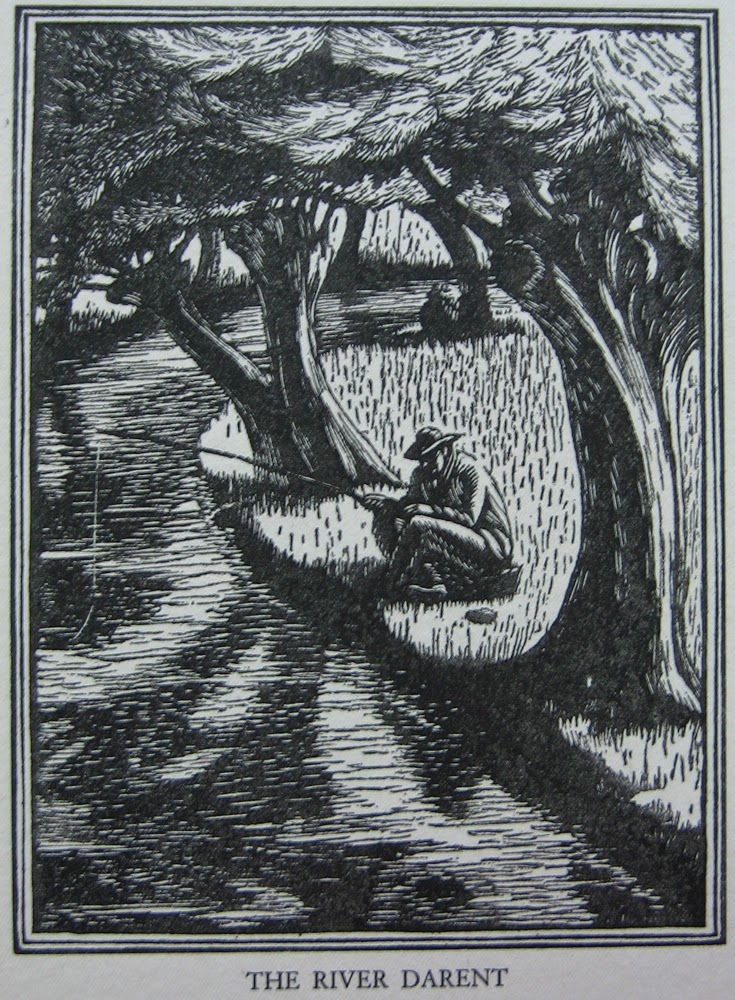
Gwen Raverat (1885-1957), The River Darent
Wood engraving, 1931

Gwen Raverat, The River Ver
Wood engraving, 1931

I have just waved goodbye to the five prints I am lending to this exciting show. They show a very varied range of female art, from Dorothea Tanning's transgressively sexualised La Marée and Untitled (En chair et en or) to Gwen Raverat's idyllic views of the English rivers of the Darent (in Kent) and the Ver (in Hertfordshire), via Joan Mitchell's cool and collected spatial abstraction for Fresh Air School. I am very pleased that these prints will take their place on the walls of Studio 3 alongside such varied and interesting company. For anyone who can get there, there will be a lecture on Gwen Raverat and her wood engravings on Saturday 31 May from 14.00 to 16.00, given by her grandson William Pryor. Other lectures include Gill Saunders, Senior Curator of Prints at the V&A, on women printmakers, Paul Coldwell on the studio of Paula Rego, and Anita Klein on beauty in art.

Thursday, December 5, 2013

Tears of rage, tears of grief: Käthe Kollwitz and her circle

Käthe Kollwitz and Paula Modersohn-Becker are the two most famous female artists in early twentieth-century Germany, but they were by no means alone: there are plenty of interesting women working alongside them. Gabriele Münter, Jacoba van Heemskerck, and Marianne von Werefkin are just three of the more well-known names. As I've recently acquired two etchings by Kollwitz, I thought I'd post these alongside some work by other female artists of the period with less of a public profile.

Käthe Kollwitz was born Käthe Schmidt in Königsberg in 1867. She made her initial studies at an art school for women in Berlin, where her teacher was Karl Stauffer-Bern; she then went to the Women's Art School in Munich. From 1891 she lived and worked in Berlin, where her husband Karl was a doctor. Kollwitz is widely recognised as one of the most important etchers of her day. Her art expresses a profound sympathy with the lives of the poor, as in her early masterworks for the series The Revolt of the Weavers.


Käthe Kollwitz, Der Sturm (The Riot)
Etching for The Revolt of the Weavers, 1897
Ref: Klipstein 33

Two further themes in the work of Käthe Kollwitz are her loathing of war and the suffering it brings (she herself lost both of her sons to the great conflicts of the twentieth century), and her profound self-questioning, in a sequence of some 50 self-portraits. I can't think of any artist other than Rembrandt who has examined themselves with such unflinching honesty as Käthe Kollwitz. The sense of anguish in the self-portrait below is almost tangible.

Käthe Kollwitz,  Selbstbildnis, mit der Hand an der Stirn (Self-portrait, hand at the forehead)
Etching, 1910
Ref: Klistein 106 iib

Clara Siewert, who was born in 1862, was a close friend of Käthe Kollwitz, with whom she studied under Karl Stauffer-Bern. When Clara Siewert moved to Berlin in 1900 she lived in the same house as Ernst Ludwig Kirchner and Max Pechstein; she also good friends with Max Slevogt and Lovis Corinth. Clara Siewert was born in Budda, East Prussia, and died in Berlin.

Clara Siewert, Junges Mädchen (Young Girl)
Lithograph, 1908

Although (as with Kollwitz) much of her work was destroyed in WWII when her studio was hit by a bomb, the art of Clara Siewert is being rediscovered today, amid new interest in the work of women artists. There was a retrospective exhibition with catalogue in 2008: "Clara Siewert - zwischen Traum und Wirklichkeit" in the Kunstforum Ostdeutsche Galerie, Regensburg. Like Käthe Kollwitz, Clara Siewert died in 1945, having lived through two cataclysmic world wars and endured the miseries of the Third Reich.

Sella Hasse, Kohlenlöschen im Schnee (Unloading Coal in the Snow)
Etching, 1913

The artist Sella Hasse was born in Bitterfeld in 1878, and died in Berlin in 1863. She studied under Walter Leistikow, Franz Skarbina, and Lovis Corinth. Sella Hasse was a socially-committed artist, who became a close friend of Käthe Kollwitz. Her work was declared "degenerate" by the Nazis. There is a collection of her paintings and watercolours in the Wismar Museum.

Erna Frank, Rue Berger in Paris
Lithograph, 1913

The etcher, lithographer and pastellist Erna Frank was born in Cologne in 1881. She studied under Paul Baum, and lived and worked in Berlin. In 1914 Erna Frank won the bronze medal at the international graphics exhibition the Bugra Leipzig. Erna Frank's etchings were published by Hermann Abell, Paul Cassirer, and J. B. Neumann, and in the Leipzig art revue Zeitschrift für Bildende Kunst. The cityscape was her favored subject. Erna Frank died in 1931

Marie Gey-Heinze, Frühling (Spring)
Etching with aquatint, 1906

Despite the title of this blog post, I can't be sure that my next two subjects knew Käthe Kollwitz personally, but they would certainly have been aware of her art, as they were working at the same time, and contributing to the same art revues - so in the circle of influence, at least. The painter and printmaker Marie Caroline Gey-Heinze was born in Cologne in 1881. Born Marie Caroline Gey, she studied under Otto Fischer at the Dresden Academy. She married the Leipzig physician Paul Heinze and quickly made a reputation for herself under the name Marie Gey-Heinze with pastels and also with etchings such as Spring and Guinea-pigs (Meerschweinsen) published by Zeitschrift für Bildende Kunst.

Marie Gey-Heinze, Meerschweinchen (Guinea-pigs)
Etching, 1908

Sadly, Marie Gey-Heinze's promising career was to come to an end when she shot herself at the age of 26, in her home in Oetzsch. There is a memorial Marie Gey Fountain in Dresden, designed by George Wrba.

Marie Stein, Porträtstudie (Portrait Study)
Etching, 1899

The etcher Marie Stein (Marie Stein-Ranke) was born in Oldenburg in 1873, into a Jewish family. Unable because she was a woman to study at the Düsseldorf Academy, she chose to study in the ateliers of Walter Petersen, Friedrich Fehr, and Paul Nauen. From 1896-1898 she lived and worked in Paris, before returning to Düsseldorf and becoming a successful society portraitist. Her closest artistic friend was the landscapist Georg Müller. In 1904 Marie Stein was awarded third prize in the annual competition of the revue Zeitschrift für Bildende Kunst, judged by Klinger, Liebermann, Köpping, Tschudi, Lehrs, and Graul.

Marie Stein, Bildnis (Portrait)
Etching, 1905

In 1906 Marie Stein married the eminent Egyptologist Hermann Ranke. Their life together was happy but blighted by the untimely deaths of their three children, and persecution by the Nazis because of Marie Stein's Jewish background. The bulk of her artist activity appears to date from before her marriage. Marie Stein-Ranke died in Nussloch near Heidelberg in 1964.

Monday, August 15, 2011

Animal grace: Norbertine Bresslern Roth

Norbertine Bresslern-Roth was born Norbertine Roth in Graz, Austria, in 1891, Bresslern-Roth was one of the pre-eminent linocut artists of the twentieth century, and one of the first to truly explore the possibilities of the medium. Her work had a profound influence on later linocut artists such as Lill Tschudi, while her own choice of subjects (chiefly animals and birds) and compositional style were influenced by the art of L. H. Jungnickel. Charles at Modern Printmakers has an excellent post on Bresslern-Roth, in which he is slightly dismissive of her as essentially an imitator of Ludwig Jungnickel, and while I think it is true that she derived a great deal from him, I do believe her work has its own strengths. Pre-eminent among these is her ability to capture a sense of motion and energy in a static image. "Kampf", her energetic depiction of a fight-to-the-death between a lobster and an octopus is a striking case in point.

Norbertine Bresslern-Roth, Kampf
Linocut, 1923

Bresslern-Roth studied under Alfred von Schrötter at the Graz Academy, then under Ferdinand Schmutzer at the Vienna Academy, and finally at Hans Hajek's school for animal painting in Dachau. Norbertine Bresslern-Roth then returned to Graz, where she lived for the rest of her life. Although she had exhibited with the Vienna Secession from 1912, Norbertine Bresslern-Roth essentially stood aside from the artistic currents of her time. A trip to North Africa in 1928 profoundly influenced her subsequent subject matter and colouring. Her linocuts are very richly inked, and the colours positively glisten from the page. My other prints by, or after, Bresslern-Roth are a series of these linocuts reproduced as lithographic facsimiles. In these, the colours, while true, have a dusty feel in comparison to  the glowing quality of the original linocuts. But they are still powerful and attractive, and I add some to this post to give a more balanced view of her output than "Kampf" alone. The lithographs were made for the book Linolschnitte von Norbertine Bresslern-Roth by Alphons Poller (1926). Bresslern-Roth evidently authorized them, but how closely she was involved beyond that is not clear. Quite probably she would have approved the proofs.

Norbertine Bresslern-Roth, Baviane
Lithograph after a linocut, 1926

Norbertine Bresslern-Roth, Feuersalamander
Lithograph after a linocut, 1926


Norbertine Bresslern-Roth, Fischer
Lithograph after a linocut, 1926


Norbertine Bresslern-Roth, Flucht
Lithograph after a linocut, 1926


Norbertine Bresslern-Roth, Galago
Lithograph after a linocut, 1926


Norbertine Bresslern-Roth, Reiher
Lithograph after a linocut, 1926


Norbertine Bresslern-Roth, Überfall
Lithograph after a linocut, 1926


Norbertine Bresslern-Roth, Ura
Lithograph after a linocut, 1926


Norbertine Bresslern-Roth, Urishirsche
Lithograph after a linocut, 1926


Although she lived until 1978, Norbertine Bresslern-Roth's era was the 1920s and 30s. In 1930, for instance, she was selected as the subject of the seventh monograph in the series Masters of the Colour Print edited by Malcolm C. Salaman and published by The Studio. As well as Salaman's rather gushing text, this had eight tipped-in colour plates (screened four-colour reproductions). This was probably the high point of her international fame, though her art has come back into focus recently through the close attention paid to it in the blogs Modern Printmakers and Art and the Aesthete.

Sunday, May 1, 2011

Say something, Edith - Little-known linocuts of Claude Flight and Edith Lawrence

"Say something, Edith." This catchphrase in my wife's family, spoken whenever anyone is feeling too tired or bored to amuse themselves, took my fancy long before I knew anything about the man who coined it, Claude Flight, or the wonderful group of linocut artists he inspired, the Grosvenor School. The Grosvenor School artists include Cyril Power, Sybil Andrews, Eileen Mayo, Lill Tschudi, Ethel Spowers, Dorrit Black, and Eveline Symes, as well as Claude Flight himself, and his life-partner Edith Lawrence. Flight founded the Grosvenor School of Modern Art with Iain MacNab, Cyril Power and Sybil Andrews, and taught there from 1926-1930. After that, he taught informally at summer schools in his neolithic chalk cave at Chantemesle on the banks of the Seine, which he had bought while serving in France in WWI. The Grosvenor School of Modern Art was located in London, at 33, Warwick Square.

William Kermode, At 33, Warwick Square
Woodcut, 1930

Born in 1881, Walter Claude Flight was the most influential figure in the development of the colour linocut as a key element of the Modernist aesthetic. Influenced by the Futurists, Flight embraced the linocut as a truly democratic art form, and one that was capable of expressing the power, energy, and expressive movement of the Machine Age. Flight was a cousin of the writer Rudyard Kipling. He had tried various careers - including engineering and beekeeping - before he entered Heatherley's School of Fine Art in 1913. Although his time at Heatherley's was cut short by the outbreak of WWI, the relationships he forged there were crucial to the development of Flight's art. One notable fellow-student was C. R. W. Nevinson, who introducted Flight to the work of the Futurists. Flight married a fellow-student, Clare James, in 1915. This marriage produced two daughters, but did not last. From 1922 until his death, his companion was a fellow linocut artist, and textile designer, Edith Lawrence (1890-1973). Flight and Lawrence shared an exhbiition of textiles and linocuts at the Redfern Gallery in 1928. All of my linocuts by Claude Flight come from the book Christmas and other Feasts and Festivals: A Picture Commentary for Grown-Ups, published by George Routledge in 1936. The book is credited to Claude Flight (who is the author of the brief introduction), but the 45 two-colour linocuts that follow are "Printed from Linoleum Blocks cut by Claude Flight and Edith Lawrence". The printer was Headley Brothers; the cuts are printed on both sides of the paper, back-to-back.

Claude Flight & Edith Lawrence, The First Feast
Linocut, 1936


Claude Flight & Edith Lawrence, Trooping the Colour
Linocut, 1936

Claude Flight & Edith Lawrence, Nursery Tea
Linocut, 1936

Claude Flight & Edith Lawrence, English Picnic
Linocut, 1936

Claude Flight & Edith Lawrence, French Picnic
Linocut, 1936

There is no way of knowing which hand cut which line, and the linocuts must be credited as joint productions of Flight and Lawrence; this method of joint creation was also employed by two other notable linocut artists of the Grosvenor School, Sybil Andrews and Cyril Power, working as Andrew-Power. I love the sly, quirky humour of these vibrant linocuts, which show both Claude Flight's sureness of line, and the ready wit with which Edith Lawrence was able to respond in a moment to the challenge, "Say something, Edith."


Claude Flight & Edith Lawrence, Knocken Moddens
Linocut, 1936

Claude Flight & Edith Lawrence, The Christening
Linocut, 1936

Claude Flight & Edith Lawrence, Bump Supper
Linocut, 1936

Claude Flight & Edith Lawrence, Winkle Barrow
Linocut, 1936

Claude Flight & Edith Lawrence, Cocktail Party
Linocut, 1936

Claude Flight is now seen as a pioneering Modernist, and it is ironic to note that he was expelled from the Seven and Five Society because of Ben Nicholson's rigorous doctrinaire insistence on abstraction as the only way forward for art.


Claude Flight & Edith Lawrence, A School Treat
Linocut, 1936

Claude Flight & Edith Lawrence, Maypole Dance
Linocut, 1936

Claude Flight & Edith Lawrence, Café Chantant
Linocut, 1936

Claude Flight & Edith Lawrence, Summer Holidays
Linocut, 1936

Claude Flight & Edith Lawrence, Chelsea Arts Ball
Linocut, 1936

Claude Flight and Edith Lawrence moved from their London home and studio at 5, Rodmarton Mews, off Baker Street, to a cottage in Wiltshire to escape the Blitz in WWII. While they survived, their London studio and their linoleum blocks did not, being destroyed by bombing in 1941. After suffering a stroke in 1947, Claude Flight had to stop creating art. He died in 1955.

Emma Bradford, Window at Wood Cottage
Etching, c.1979

Their Wiltshire home was Wood Cottage, Pigtrough Lane, Donhead St Andrew. I can give you a glimpse of it as it was in 1979, in an etching by my wife, Emma Bradford. There is also a very evocative description of what I take to be Wood Cottage (or if, not, one uncannily like it) in Jane Gardam's novel The Man in the Wooden Hat.