Showing posts with label Dorothea Tanning. Show all posts

Thursday, April 24, 2014

Underexposed: Female Artists and the Medium of Print

Underexposed: Female Artists and the Medium of Print is an exhibition on a subject close to my heart, the importance of female printmakers, and the relative neglect their art still receives. Regular readers of this blog will remember my posts on artists such as Angèle Delasalle, Ghislaine de Menten de Horne, Käthe Kollwitz, Laura Malclès-Masereel, Lill Tschudi, Norbertine Bresslern-Roth, Terry Haass, Tirzah Garwood (Ravilious), and others. Underexposed will run from 16 May to 19 June at Studio 3 Gallery, University of Kent School of Arts, Canterbury, with an associated programme of free lectures. It has been curated by Frances Chiverton and Lynne Dickens, and you can find out more about it here. I would reproduce the beautiful poster for the show, but I can't work out how to do so. Among the many artists included are Alison Wilding, Anne Desmet, Barbara Hepworth, Berthe Morisot (about whom I have a post-in-the-making), Bridget Riley, Cornelia Parker, Elisabeth Frink, Leonora Carrington, Louise Bourgeois, Paula Rego, Rose Hilton, Sandra Blow, Sarah Lucas, Sonia Delaunay, and Tracey Emin.

Dorothea Tanning (1910-2012), La Marée 5
Etching with aquatint, 1970

Dorothea Tanning, Untitled (En chair et en or)
Lithograph, 1975

Joan Mitchell (1925-1992), Untitled (Fresh Air School)
Lithograph, 1972
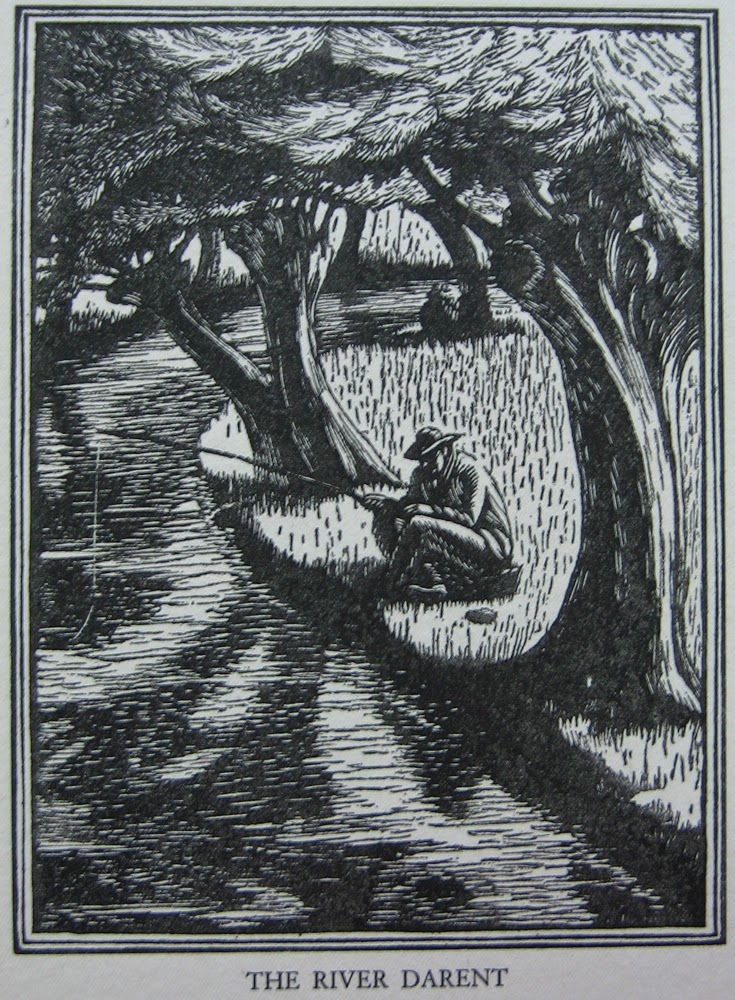
Gwen Raverat (1885-1957), The River Darent
Wood engraving, 1931

Gwen Raverat, The River Ver
Wood engraving, 1931

I have just waved goodbye to the five prints I am lending to this exciting show. They show a very varied range of female art, from Dorothea Tanning's transgressively sexualised La Marée and Untitled (En chair et en or) to Gwen Raverat's idyllic views of the English rivers of the Darent (in Kent) and the Ver (in Hertfordshire), via Joan Mitchell's cool and collected spatial abstraction for Fresh Air School. I am very pleased that these prints will take their place on the walls of Studio 3 alongside such varied and interesting company. For anyone who can get there, there will be a lecture on Gwen Raverat and her wood engravings on Saturday 31 May from 14.00 to 16.00, given by her grandson William Pryor. Other lectures include Gill Saunders, Senior Curator of Prints at the V&A, on women printmakers, Paul Coldwell on the studio of Paula Rego, and Anita Klein on beauty in art.

Wednesday, November 7, 2007

The tide is high


Dorothea Tanning, La Marée IV

Cinemagoers of a certain age will remember the short film La Marée (The Tide), which was incorporated as the first of Walerian Borowczyk’s Immoral Tales, released in 1977 when Borowczyk was still an arthouse darling. It tells the story of a young man who uses the hypnotic rhythm of the incoming tide to seduce his cousin. The film was based on a novella by André Pieyre de Mandiargues, a writer associated both with the nouveau roman and with Surrealism. Like so many French writers, Mandiargues had many artist friends (and was married to an artist, Bona de Mandiargues). Among these friends was the American Surrealist Dorothea Tanning, who in 1970 created a suite of etchings with colour aquatint inspired by La Marée.

90 copies of a limited edition of the Tanning version of La Marée were published by Éditions Georges Visat, with the etchings printed on Arches. In addition, 90 suites of the etchings were printed on Japon nacré, hand-signed and justified by Dorothea Tanning.


Dorothea Tanning, La Marée V

I’ve been lucky enough to acquire one of these suites of Dorothea Tanning etchings, and they seem to me to rank among her finest work. She doesn’t try to illustrate the text in a direct way. Instead she responds to it, with a matching blend of eroticism, tension, and longing. Many of the images are almost abstract. Figures of a young man and a young woman merge with rocks and waves. And of course what a photograph can’t show is the sheer physicality of the prints themselves.


Dorothea Tanning, La Marée VII

I’ve only got one other Dorothea Tanning print, a lithograph related to her series En chair et en or, which was a 1973 suite of etchings with aquatint, in which distorted orgiastic forms further explore the surrealistic recesses of sexuality. These are very powerful works, but I prefer the more tender, even romantic, quality of her etchings for La Marée.


Dorothea Tanning, Untitled (En chair et en or)

Dorothea Tanning was Max Ernst’s third wife (after Marie-Berthe Aurenche and Peggy Guggenheim). Tanning has been rather wittily called “the oldest living Surrealist widow”; she was born in 1910, so she is fast approaching her centenary.